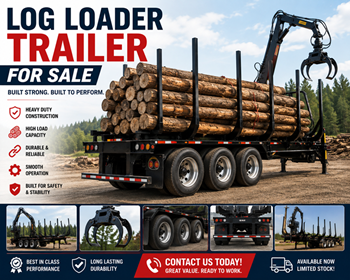
Moving logs efficiently requires coordination between equipment positioning, lifting movements, and transportation planning. A trailer log loader offers a practical approach to mechanical timber handling when its lifting capabilities and operating requirements match the worksite. Understanding loading precision, operator visibility, and equipment stability can help create a smoother woodland workflow.
Why Loading Precision Matters
Timber loading involves more than lifting a log from the ground.
Each movement must position the material accurately without disturbing surrounding logs or creating an unstable load.
Poorly controlled movements may require repeated adjustments, increasing handling time.
Precise loading helps operators arrange timber securely and maintain a consistent working rhythm.
Controlling Log Movement
Logs can rotate or swing during lifting, particularly when their weight is unevenly distributed.
Operators should use appropriate gripping arrangements and smooth control movements.
Sudden directional changes can introduce unwanted motion.
Maintaining a clear exclusion zone around suspended timber is essential throughout the loading process.
Positioning Equipment for Effective Operation
A trailer log loader works most efficiently when the equipment is positioned with sufficient space for lifting and rotation.
Before beginning work, inspect the surrounding area for overhead obstacles, unstable ground, and restricted movement.
Establish a Stable Working Position
The supporting surface must be suitable for the equipment’s loaded condition.
Where stabilizing components are fitted, deploy them according to manufacturer instructions.
Avoid attempting lifts that exceed rated capacity or create excessive sideways loading.
A stable setup provides the foundation for controlled handling.
Improving Operator Visibility
Clear visibility helps operators identify the location of logs, nearby obstacles, and the position of the loading area.
Restricted sightlines can increase the difficulty of precise movements.
Maintain Clear Working Zones
Remove unnecessary material from the immediate loading area.
Position logs where they can be approached without excessive maneuvering.
When additional personnel are involved, establish clear communication procedures before operating.
Never permit workers to enter a hazardous lifting area simply to guide suspended timber by hand.
Organizing Logs for Faster Loading
An effective loading sequence begins before the first lift.
Grouping timber by approximate size reduces unnecessary sorting during equipment operation.
Place accessible logs where the lifting mechanism can reach them within its rated working range.
Build Balanced Loads
Arrange timber to maintain appropriate weight distribution.
Heavier pieces should be positioned according to the equipment manufacturer’s loading guidance.
Keep material within designated supports and secure it with suitable restraints.
An organized load reduces the need for repositioning before transportation.
Understanding Hydraulic Performance
Hydraulic systems commonly control lifting, rotation, and gripping movements.
Their responsiveness influences how smoothly operators can position material.
Regular inspection of hoses, connections, fluid condition, and moving joints helps maintain reliable operation.
Avoid Unnecessary Mechanical Stress
Operating beyond rated limits can place excessive loads on structural and hydraulic components.
Smooth control inputs, appropriate lifting techniques, and regular lubrication help reduce avoidable wear.
Any unusual noise, movement, or leakage should be investigated before continuing work.
Developing Consistent Operating Habits
Productivity improves when operators follow repeatable procedures.
Begin with a worksite inspection, establish equipment stability, organize timber, and complete loading systematically.
After transportation, inspect equipment for damage or loose components.
A forestry handling equipment information point may provide additional regional context for operators reviewing timber loading arrangements.
Conclusion
A trailer log loader can support efficient timber handling when operators prioritize precise movements, stable positioning, and balanced loading. Good visibility and organized material placement reduce unnecessary adjustments, while regular inspections support reliable performance. By developing consistent operating habits, woodland workers can improve productivity while maintaining careful control over demanding lifting activities.